The Chemistry of Electrolytes · Episode 03
How much salt do you lose in sweat? An Australian summer, in numbers
Two hard hours on a roof, a site or a training session. You know you lost water. How much salt went with it is harder to guess.
Short answer. About 1,000mg of sodium an hour of hard sweating, on average. A level teaspoon of salt holds about 2,300mg. So two hard hours is close to a teaspoon gone.
Where sweat comes from
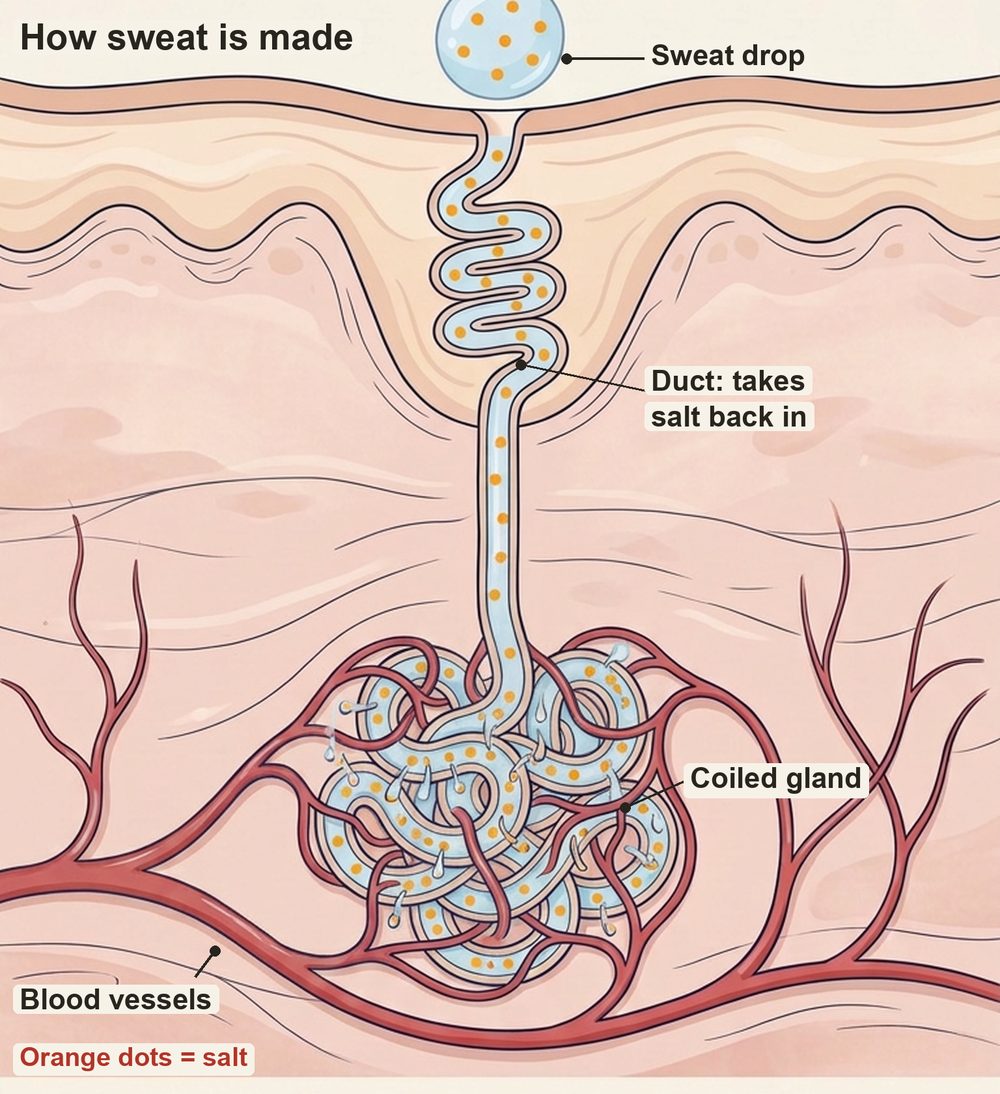
Sweat starts in a tiny coiled gland deep in your skin. The gland pulls fluid from the blood vessels around it. That fluid carries salt.
The sweat then climbs a thin tube, the duct, to your skin. On the way, the duct pulls some salt back in.
Sweat fast, and the duct can't keep up
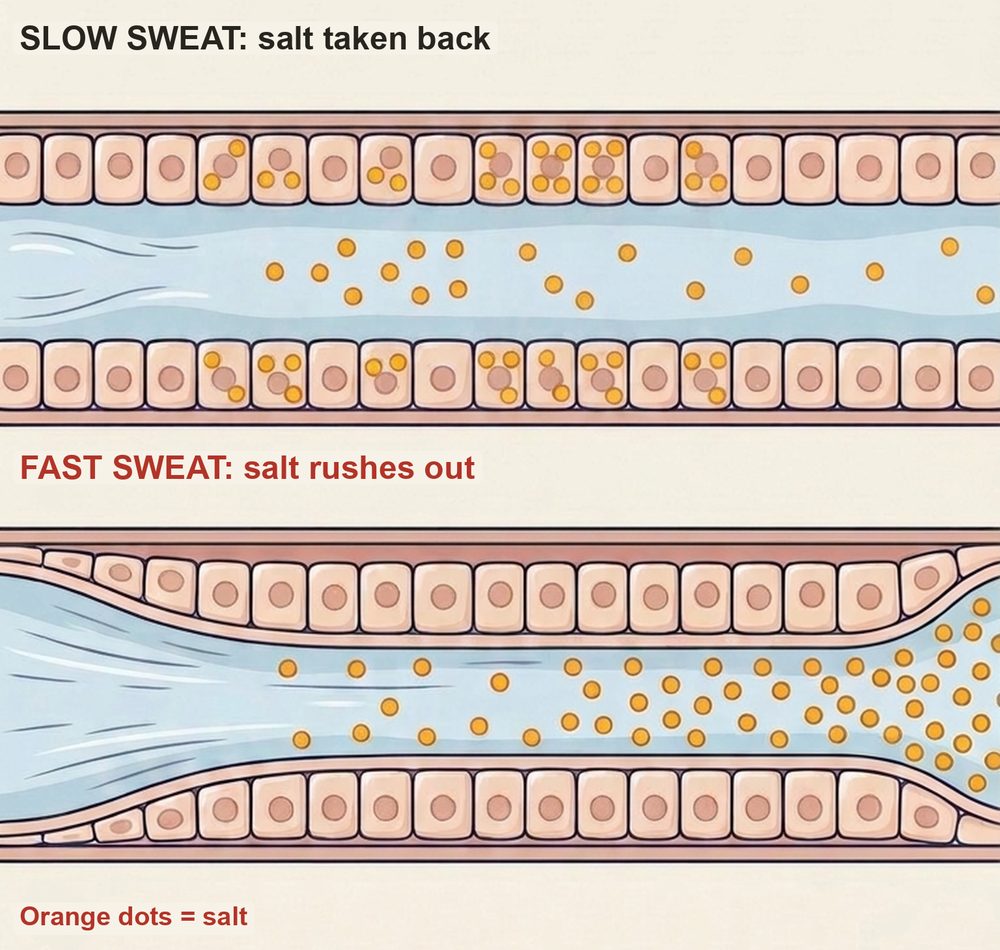
The duct can only take salt back so fast. Sweat slowly, and it reclaims a good share. Sweat hard, and the sweat rushes past. More salt ends up on your skin.
The numbers
The best data comes from sweat tests on athletes. A 2016 study of 506 athletes found they sweated about 1.2 litres an hour. That works out to about 1,000mg of sodium an hour. A later study of 1,303 athletes found much the same.
Why your number may be very different
The average hides a big spread. Some people sweat a quarter of a litre an hour. Some sweat more than five. And some people's sweat is about four times saltier than others'.
- How hard and how hot. More effort and more heat mean more sweat.
- Your body. Some people are simply salty sweaters.
- How used to the heat you are. After a week or two of regular heat, sweat gets less salty. So the first hot weeks of an Australian summer are often when you lose the most.
Are you a salty sweater?
Check your work shirt or cap after a big day. White, crusty lines where the sweat dried are salt. See them often, and your sweat is probably on the salty side. It is a hint, not a test, but it costs nothing.
What a hot shift looks like
Most of the data is from sport. But a tradie on a roof in January is doing steady, sweaty work for hours. One study of workers on 10 to 12.5 hour shifts in heat found they drank about 0.8 litres an hour just to stay hydrated.
Australian safety regulators suggest a cup of cool water (about 200ml) every 15 to 20 minutes in the heat. Don't wait to feel thirsty.
Estimate your own number
- Weigh yourself before and after a hot session. Each kilogram lost is about a litre of sweat. Add back what you drank.
- Multiply by about 800mg of sodium per litre. Use more if you often see salt lines.
Or let our free calculator do the maths.
Plain water alone can leave you short on sodium after a long, hot day. We explain why in the science of salt and hydration. Wondering how much is too much? Read is 1000mg of sodium too much?
Where Rawstone fits
Rawstone is an Australian-owned, sugar-free hydration powder with 1000mg sodium per serve. That is about one hour of average sweat. It also has 250mg potassium and 75mg magnesium, in a 7g serve mixed into 750ml of water. One serve a day; on longer days, the rest comes from your meals. Launching on Amazon Australia this summer.
See the productGet the Sodium & Hydration Cheat Sheet + a launch-day discount
Sweat rates, sodium numbers and simple checks on one page. No spam.
How much salt do you lose in sweat?
How much sodium is in a teaspoon of salt?
Am I a salty sweater?
Do you lose less salt once you get used to the heat?
Sources
- Baker LB, Barnes KA, Anderson ML, Passe DH, Stofan JR. Normative data for regional sweat sodium concentration and whole-body sweating rate in athletes. Journal of Sports Sciences. 2016;34(4):358–368. doi:10.1080/02640414.2015.1055291
- Barnes KA, Anderson ML, Stofan JR, et al. Normative data for sweating rate, sweat sodium concentration, and sweat sodium loss in athletes: an update and analysis by sport. Journal of Sports Sciences. 2019;37(20):2356–2366. doi:10.1080/02640414.2019.1633159
- Baker LB. Sweating rate and sweat sodium concentration in athletes: a review of methodology and intra/interindividual variability. Sports Medicine. 2017;47(Suppl 1):111–128. doi:10.1007/s40279-017-0691-5
- Brake DJ, Bates GP. Fluid losses and hydration status of industrial workers under thermal stress working extended shifts. Occupational and Environmental Medicine. 2003;60(2):90–96. doi:10.1136/oem.60.2.90
- SafeWork NSW. Avoiding heat-related illness: for workers. safework.nsw.gov.au
This article is general education about hydration, not medical advice. Rawstone is a formulated supplementary sports food, not a medicine, and is not intended to diagnose, treat, cure or prevent any disease. Consume no more than one serve a day. If you have a condition that means you need to manage your sodium or fluid intake, talk to your doctor before using any high-sodium product.