The Chemistry of Electrolytes · Episode 05
Why not just put salt in your water?
It's a fair question. Salt is cheap, it's already in your pantry, and it gives you sodium. So what does a mix add?
Short answer. Salt water works for sodium. But table salt has almost no potassium or magnesium. Every cell in your body runs a pump that uses all three. Salt water brings one of them.
Salt water does one job well
Table salt is sodium chloride. About 39% of it, by weight, is sodium. A bit under half a level teaspoon (about 2.6g) gives you roughly 1,000mg of sodium.
That is a real dose. If sodium is all you want, salt water does the job. It costs almost nothing.
The catch is what it leaves out. A level teaspoon of table salt has under 1mg of potassium and under 0.1mg of magnesium. That is next to zero.
The pump in every cell
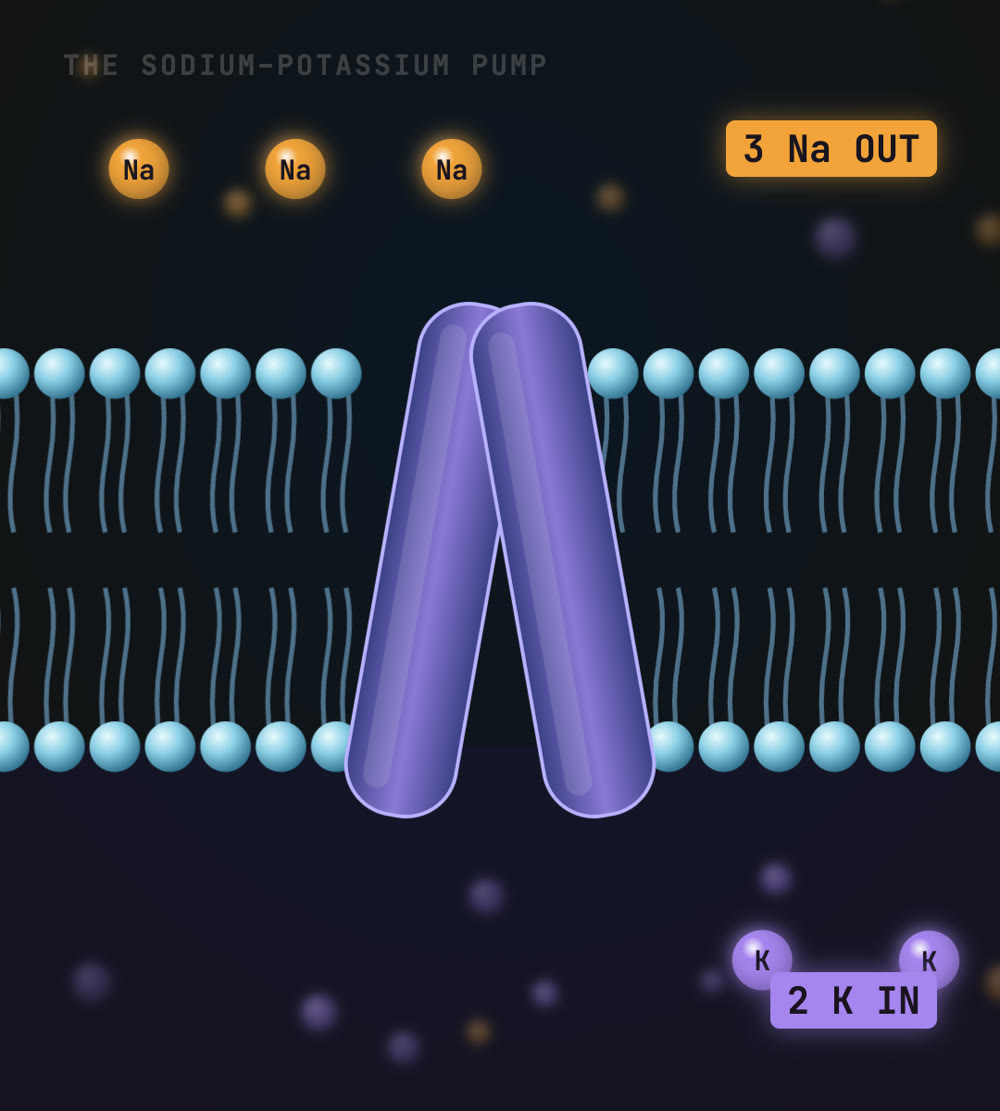
Every cell in your body has tiny pumps in its wall. This one is called the sodium-potassium pump. A Danish scientist, Jens Skou, found it in 1957. He later won a Nobel Prize for it.
Each cycle, the pump pushes three sodium out of the cell and pulls two potassium in. That keeps sodium high outside the cell and potassium high inside. Those two levels set up the charge your nerves and muscles send their signals on.
Its fuel needs magnesium
The pump runs on ATP, the fuel your cells make. But ATP doesn't work on its own. In the body, it works bound to magnesium, as a pair called Mg-ATP.
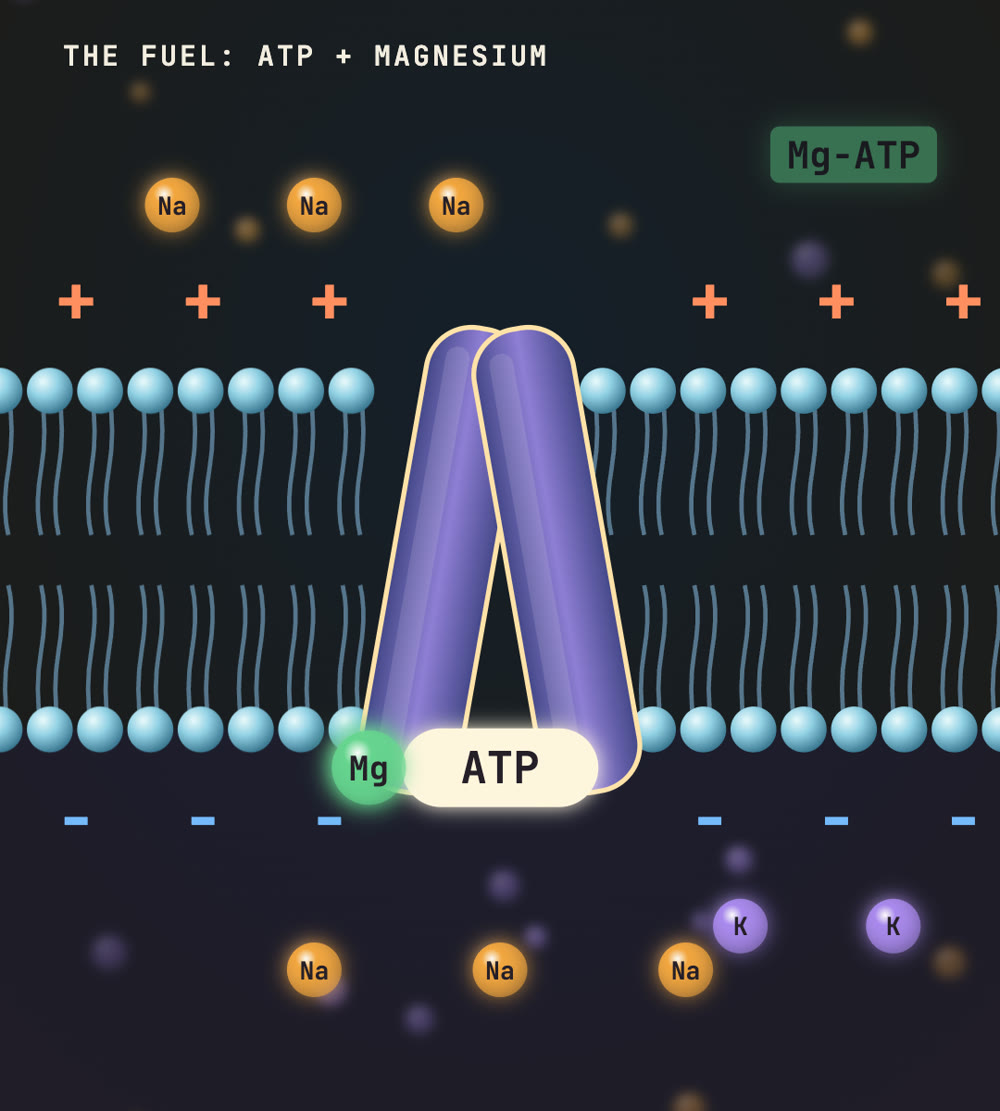
So the pump uses three minerals: sodium, potassium and magnesium. Salt water brings one.
Could you make your own full mix?
You could. You would need salt, a potassium powder, a magnesium powder and a kitchen scale that weighs to a tenth of a gram. Then you would need to like the taste. Plain potassium and magnesium salts are bitter, and salt water is, well, salty water.
| DIY salt water | A measured mix | |
|---|---|---|
| Cost | Wins. Cents a glass | More per serve |
| Already in the pantry | Wins | You have to buy it |
| Sweetener | None at all | Most use one |
| Potassium + magnesium | Almost none | Wins. In the same scoop |
| Same dose every time | Depends on your teaspoon | Wins. Measured |
| Taste | Salty water | Wins. Flavoured |
If you only want sodium and don't mind the taste, salt water is a fine choice. If you want all three in one measured scoop, a mix saves you the scale.
New to sodium numbers? Start with the science of salt and hydration and how much salt you lose in sweat. Worried about the dose? Read is 1000mg of sodium too much? And on the magnesium form, see magnesium citrate vs oxide.
Where Rawstone fits
Rawstone is an Australian-owned, sugar-free hydration powder. Each 7g serve has 1,000mg sodium, plus the two minerals salt water leaves out: 250mg potassium (as citrate) and 75mg magnesium (as citrate). Mix one scoop into 750ml of water. One serve a day. Launching on Amazon Australia this summer.
See the productGet the Sodium & Hydration Cheat Sheet + a launch-day discount
Sweat rates, sodium numbers and simple checks on one page. No spam.
Can I just put salt in my water?
How much salt gives 1,000mg of sodium?
Does table salt have potassium or magnesium?
Is sea salt or pink salt better?
Sources
- Skou JC. The influence of some cations on an adenosine triphosphatase from peripheral nerves. Biochimica et Biophysica Acta. 1957;23(2):394–401. doi:10.1016/0006-3002(57)90343-8
- de Baaij JHF, Hoenderop JGJ, Bindels RJM. Magnesium in man: implications for health and disease. Physiological Reviews. 2015;95(1):1–46. doi:10.1152/physrev.00012.2014
- Alberts B, et al. Molecular Biology of the Cell, 4th ed. Carrier proteins and active membrane transport. ncbi.nlm.nih.gov
- U.S. Department of Agriculture. FoodData Central: Salt, table. fdc.nal.usda.gov
This article is general education about hydration, not medical advice. Rawstone is a formulated supplementary sports food, not a medicine, and is not intended to diagnose, treat, cure or prevent any disease. Consume no more than one serve a day. If you have a condition that means you need to manage your sodium, potassium or fluid intake, talk to your doctor before using any high-sodium product.