The Chemistry of Electrolytes · Episode 07
What does magnesium do in your body?
Clench your fist, then let go. Both moves need magnesium. Here's where it lives, what it does, and where you get it.
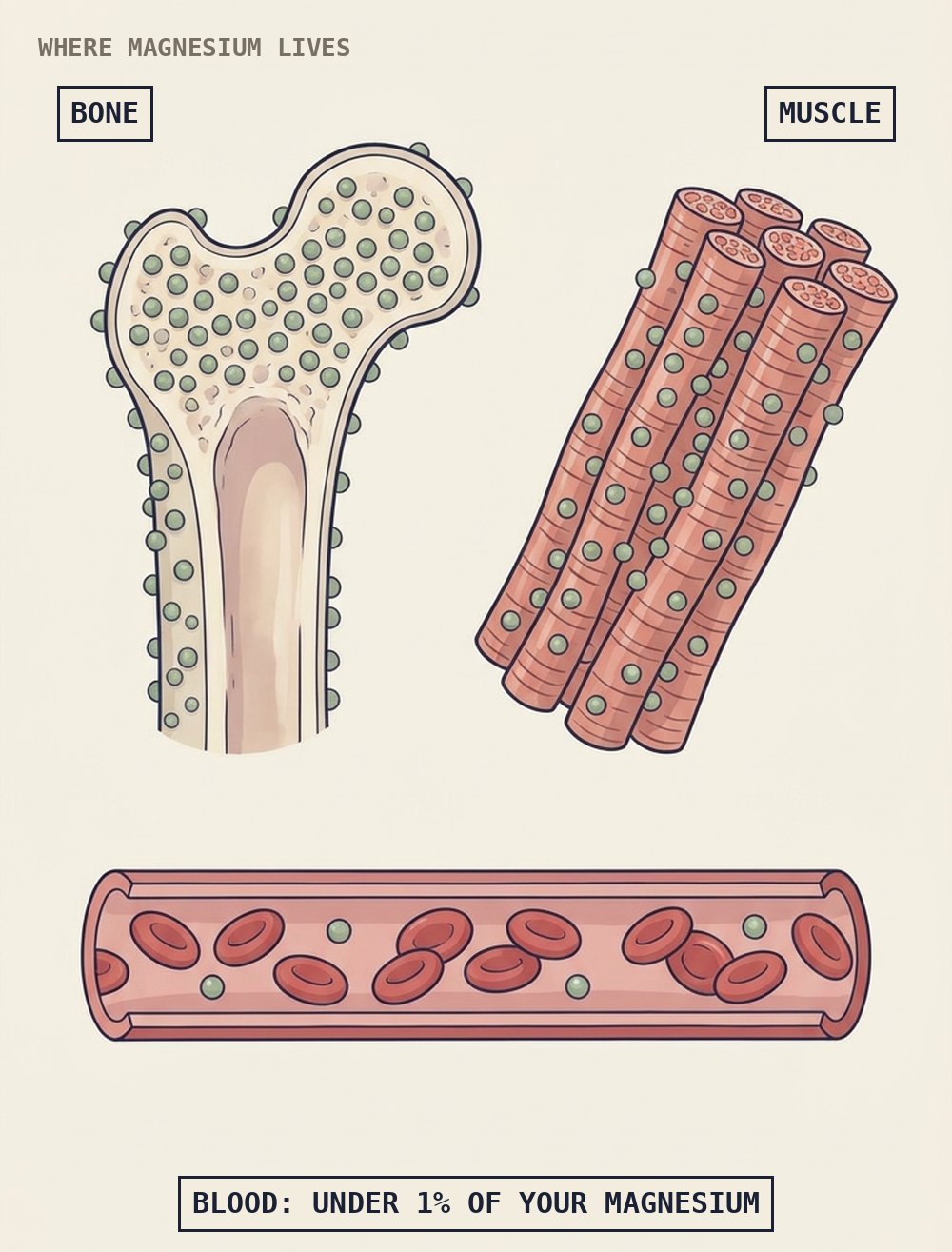
Short answer. Most of your magnesium sits in your bones and muscles. Less than 1% is in your blood. Your cells' fuel, ATP, works bound to magnesium, and in muscle that fuel runs the pumps that let a squeeze end. Sweat takes very little of it. Food is where it comes from.
Where your magnesium lives
An adult body holds about 25g of magnesium. About half or a bit more is in your bones. Most of the rest sits inside the cells of your muscles and other soft tissues.
Less than 1% is in your blood. That small share is kept steady mainly by your kidneys, with help from your gut and bones.
It works with your cells' fuel
Magnesium works in more than 300 enzyme systems. One job matters most here. ATP, the fuel every cell makes, works in the body bound to magnesium, as a pair called Mg-ATP.
That is why magnesium came up in episode 05: the pump that moves sodium and potassium across each cell's membrane runs on Mg-ATP.
What it does in a working muscle
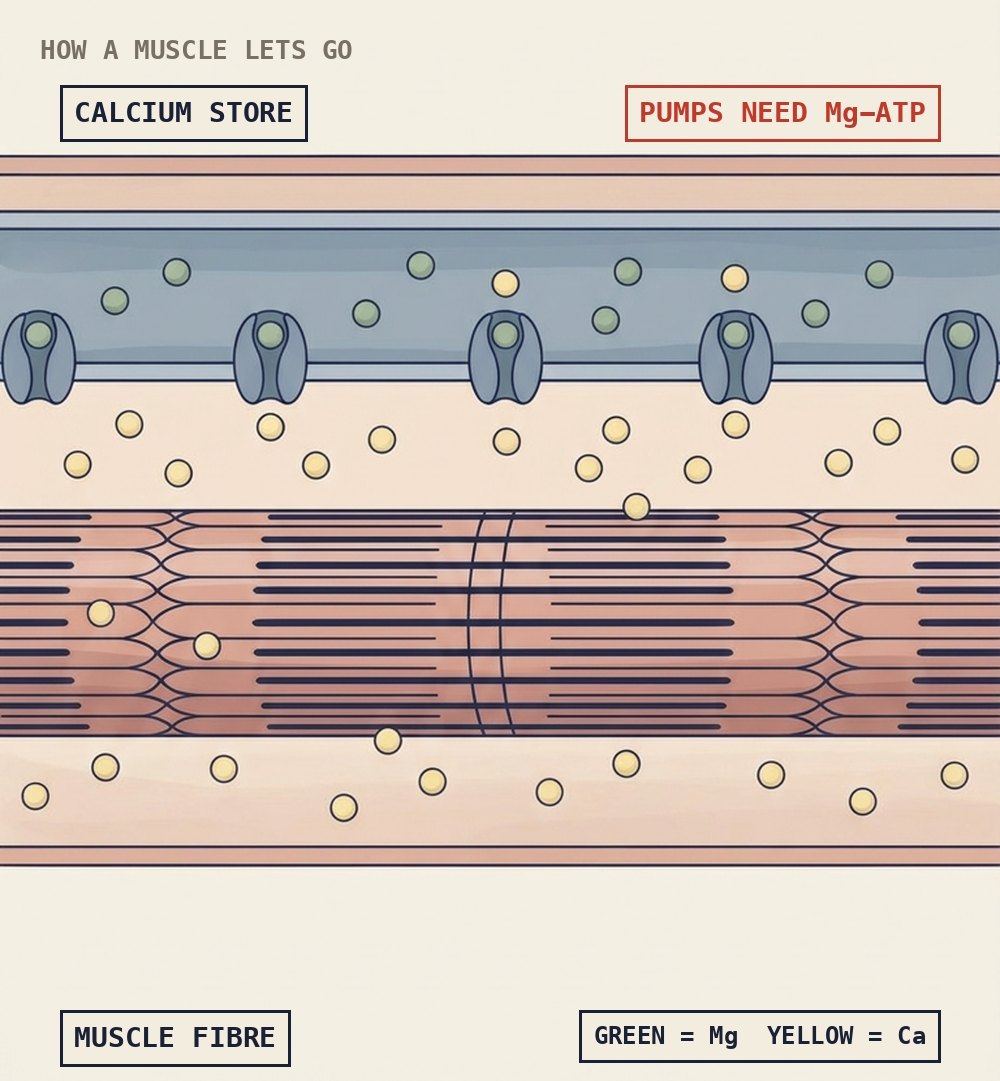
When a nerve tells a muscle to work, calcium floods out of a store inside each muscle cell. That calcium switches on the squeeze.
To let go, the cell has to clear the calcium away again. Pumps in the wall of the store pull it back in, and those pumps run on Mg-ATP. The squeeze itself uses Mg-ATP too. So both moves need magnesium.
Sweat takes very little
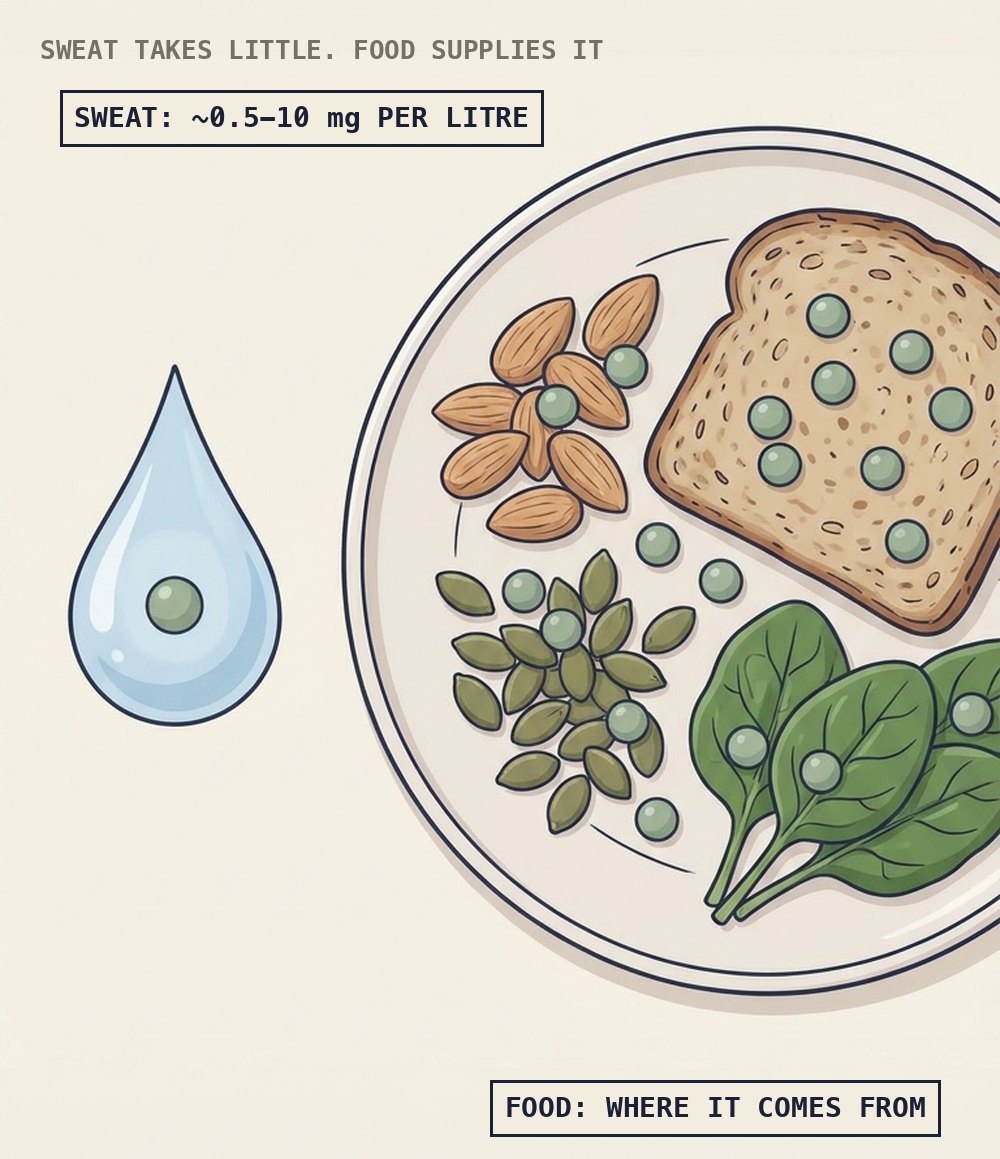
Sweat does carry some magnesium, but not much: about 0.5 to 10mg per litre. Sodium is the big loss in sweat, by a long way. See how much salt you lose in sweat.
Food is where it comes from
Australia's daily target is 320mg for women and 420mg for men from age 31 (310mg and 400mg from 19 to 30). Nuts, seeds, leafy greens, legumes and wholegrains carry the most. A small handful of almonds has about 80mg.
Most people get theirs from everyday food. In the 2023 national nutrition survey, about 3 in 10 Australians aged 2 and over ate less magnesium than they need. The easy wins are on your plate: a handful of nuts, some seeds, greens with dinner, wholegrain bread.
For the other minerals, read what potassium does and is 1000mg of sodium too much?
About Rawstone
Rawstone is an Australian-owned, sugar-free hydration powder. Each 7g serve has 1,000mg sodium, 250mg potassium (as citrate) and 75mg magnesium (as citrate). Mix one scoop into 750ml of water. One serve a day. Launching on Amazon Australia this summer.
See the productRegister for a launch-day discount
Get the Sodium & Hydration Cheat Sheet now, and a discount code when Rawstone goes live on Amazon. No spam.
What does magnesium do in the body?
Where is most of the magnesium in your body?
Do you lose much magnesium in sweat?
How much magnesium do adults need each day?
Sources
- de Baaij JHF, Hoenderop JGJ, Bindels RJM. Magnesium in man: implications for health and disease. Physiological Reviews. 2015;95(1):1–46. doi:10.1152/physrev.00012.2014
- NIH Office of Dietary Supplements. Magnesium: fact sheet for health professionals. ods.od.nih.gov
- Baker LB. Physiology of sweat gland function: the roles of sweating and sweat composition in human health. Temperature. 2019;6(3):211–259, Table 3. pmc.ncbi.nlm.nih.gov
- NHMRC. Nutrient Reference Values for Australia and New Zealand: Magnesium. eatforhealth.gov.au
- Australian Bureau of Statistics. Australians continue to need more calcium (National Nutrition and Physical Activity Survey 2023, usual intakes from food). abs.gov.au
This article is general education about hydration, not medical advice. Rawstone is a formulated supplementary sports food, not a medicine, and is not intended to diagnose, treat, cure or prevent any disease. Consume no more than one serve a day. If you have a condition that means you need to manage your sodium, potassium, magnesium or fluid intake, talk to your doctor before using any high-sodium product.