The Chemistry of Electrolytes · Episode 06
What does potassium do in your body?
Put two fingers on your wrist. Every beat you feel depends, in part, on potassium. Here's how.
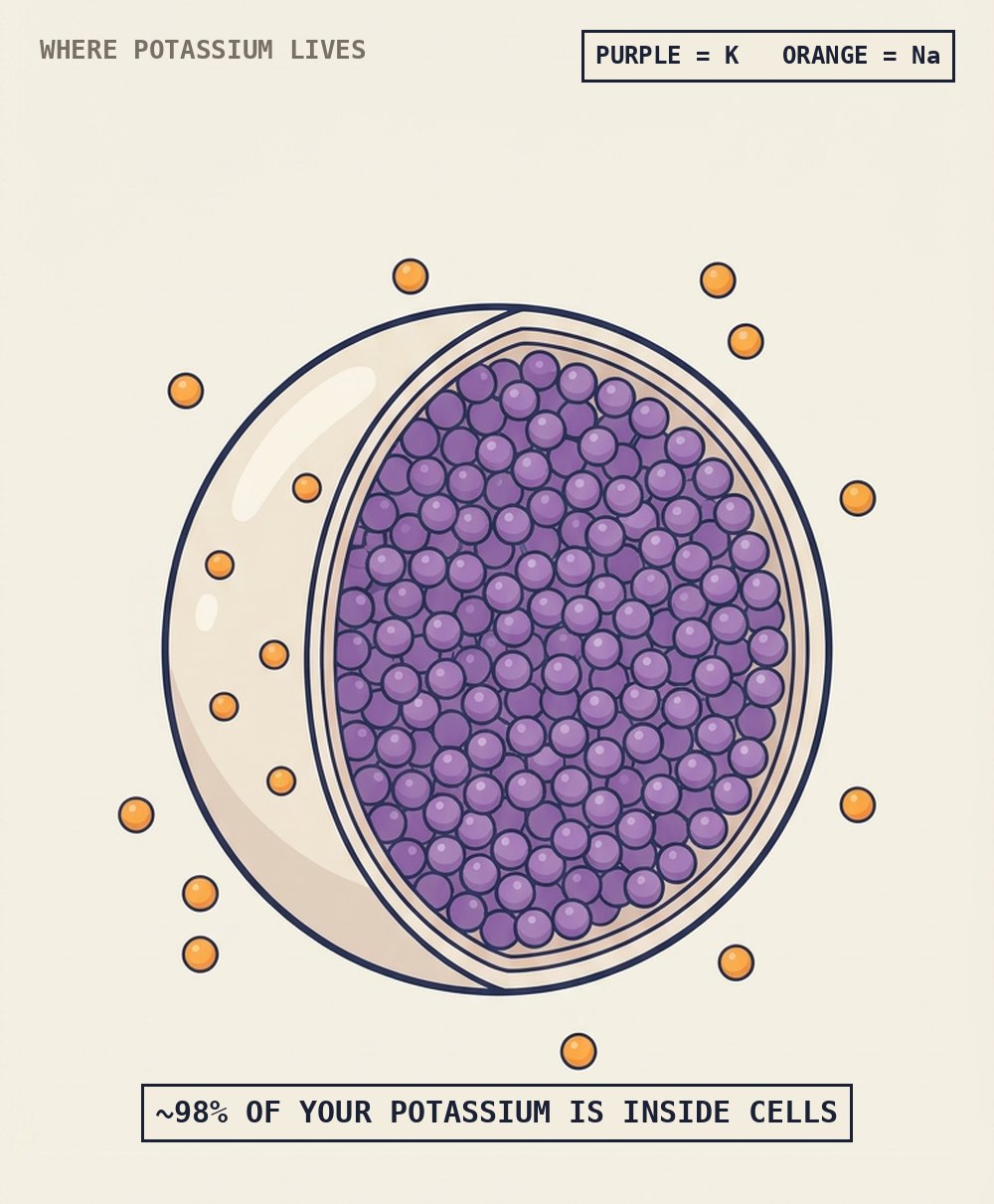
Short answer. Potassium is the mineral that lives inside your cells. About 98% of it sits inside your cells. A slow leak of it out of each cell leaves the inside a little negative, and that charge is what lets a nerve fire, a muscle squeeze and your heart keep its beat.
The mineral that lives inside you
Sodium and potassium are both electrolytes: minerals that carry a charge when they dissolve in water. They live in different places.
Sodium mostly stays outside your cells, in your blood and the fluid around your cells. Potassium is the opposite. About 98% of the potassium in your body sits inside your cells.
A small leak makes a charge
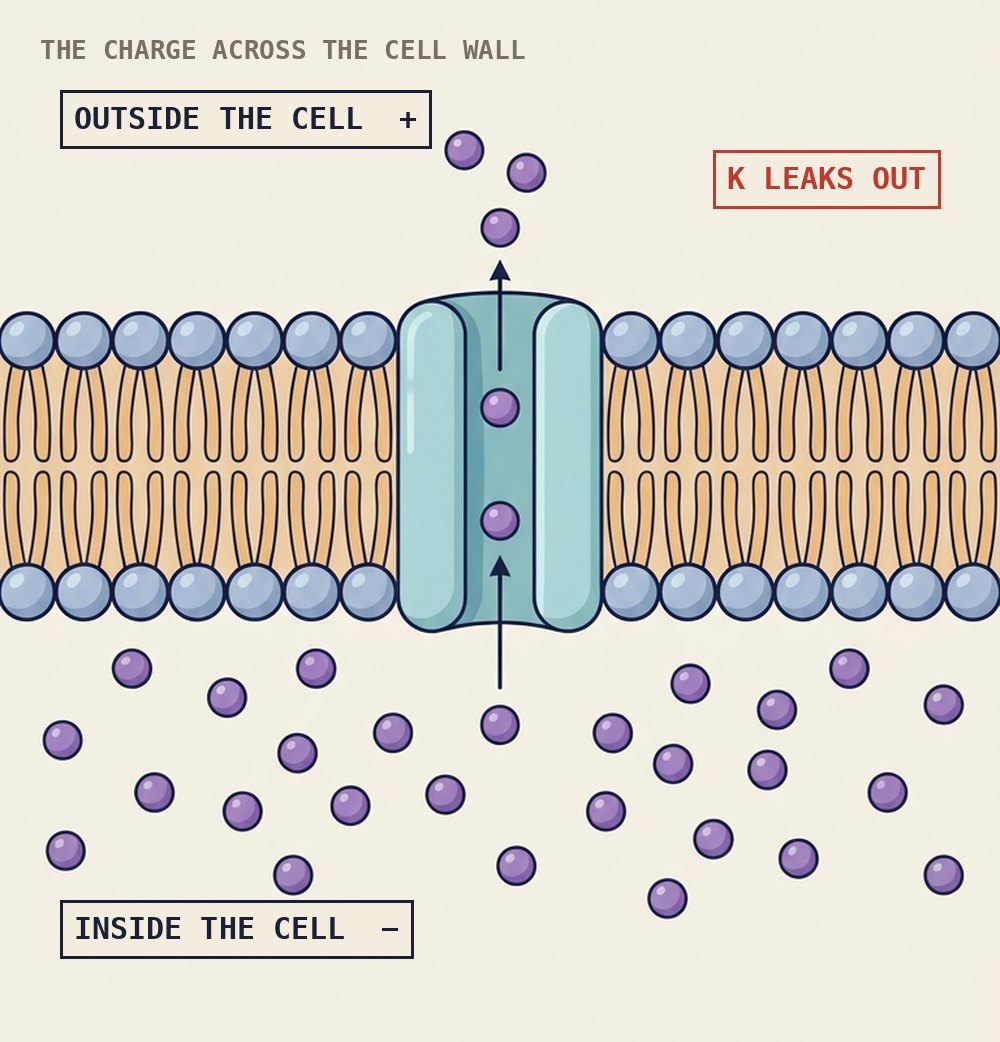
Each cell's outer skin (its membrane) has channels that let a little potassium leak out, all the time. Every potassium ion that leaves takes a positive charge with it. That leaves the inside of the cell a little negative compared with the outside.
That small charge is what your body runs on. A nerve fires when sodium rushes in and flips the charge for a moment. Potassium flowing out resets it. A muscle cell squeezes the same way. Your heart is muscle too, so every beat rides on it.
The pump from episode 05 keeps this going. It pushes sodium back out and pulls potassium back in, so the cell never runs down.
Your body keeps it in a tight band
Because so much depends on that charge, your blood potassium sits in a narrow range, about 3.5 to 5.0 mmol/L. Your kidneys clear any extra. Food tops it up.
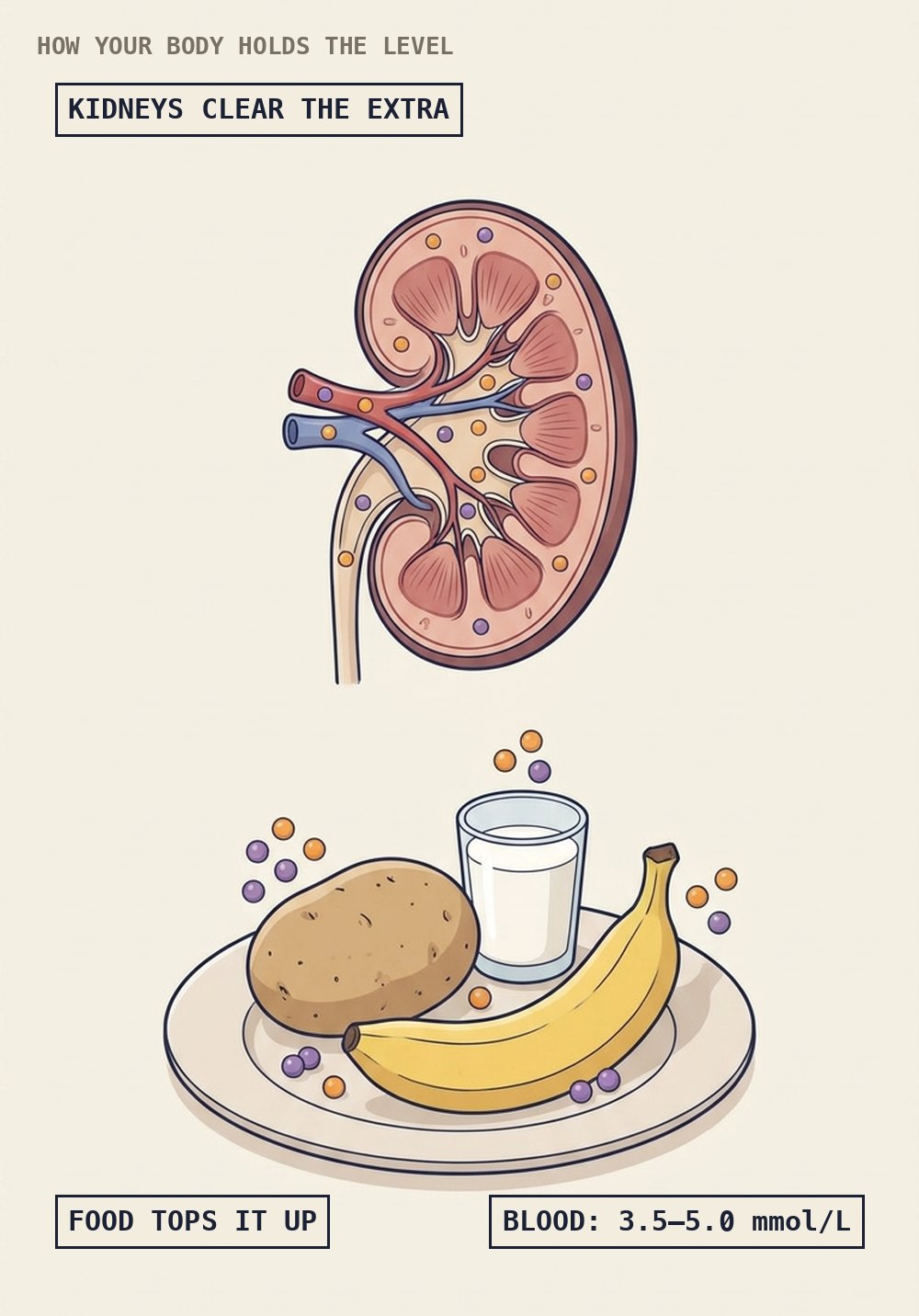
Food is where most of your potassium comes from. Potatoes, fruit, vegetables, beans and milk all carry it. A medium banana has about 519mg. Australia's Adequate Intake is 3,800mg a day for men and 2,800mg for women.
A drink is not the place to get your daily potassium. A 600ml bottle of a leading sports drink has 138mg, about a quarter of one banana. Other big brands sit around 200mg.
What sweat takes
Sweat does carry potassium, but not much. A litre holds about 80 to 310mg. It holds a lot more sodium: about 230 to 2,070mg. A typical litre has around six times more sodium than potassium, by weight.
So after a big sweat, sodium is the bigger gap. Potassium still matters, just in a smaller amount. A drink built for sweat should carry both, with sodium well in front.
For the sodium side, see how much salt you lose in sweat and is 1000mg of sodium too much? Fasting? Read do electrolytes break a fast?
Where Rawstone fits
Rawstone is an Australian-owned, sugar-free hydration powder. Each 7g serve has 1,000mg sodium and 250mg potassium (as citrate), plus 75mg magnesium (as citrate). Mix one scoop into 750ml of water. One serve a day. Launching on Amazon Australia this summer.
See the productRegister for a launch-day discount
Get the Sodium & Hydration Cheat Sheet now, and a discount code when Rawstone goes live on Amazon. No spam.
What does potassium do in the body?
Which has more potassium, a banana or a sports drink?
How much potassium do you lose in sweat?
How much potassium do adults need each day?
Sources
- Palmer BF, Clegg DJ. Physiology and pathophysiology of potassium homeostasis. Advances in Physiology Education. 2016;40(4):480–490. doi:10.1152/advan.00121.2016
- Baker LB. Physiology of sweat gland function: the roles of sweating and sweat composition in human health. Temperature. 2019;6(3):211–259, Table 3. pmc.ncbi.nlm.nih.gov
- NHMRC. Nutrient Reference Values for Australia and New Zealand: Potassium. eatforhealth.gov.au
- healthdirect. Foods high in potassium (Australian Food Composition Database). healthdirect.gov.au
- Sports drink figures: nutrition panel of a 600ml bottle of a leading Australian sports drink, checked 15 November 2026.
This article is general education about hydration, not medical advice. Rawstone is a formulated supplementary sports food, not a medicine, and is not intended to diagnose, treat, cure or prevent any disease. Consume no more than one serve a day. If you have a condition that means you need to manage your sodium, potassium or fluid intake, talk to your doctor before using any high-sodium product.